Begin with a focused question.
Gather what you know and give your AI research useful context and direction.
You’re curious about what AI could help you discover about your family. But when an answer sounds convincing and the evidence is unclear, it’s easy to feel unsure, cautious, or stuck. How do you move from a response on a screen to research you can stand behind?
Your ancestors’ lives deserve careful interpretation. You deserve a practical way to explore AI without handing over your judgment.
I’m Aisha LaDon Abdul Rahman, archivist, genealogist, and author of Speak to Me. In this live webinar, I’ll introduce the Reclamation Method and explain how its 25 protocols connect focused questions, historical context, evidence evaluation, and preservation.
Your next steps: Register, save your Google Meet details, and join with one family history question. Explore the four movements of the method and consider how they can guide your next research session with your preferred AI platform.
Your Google Meet joining details appear after registration.
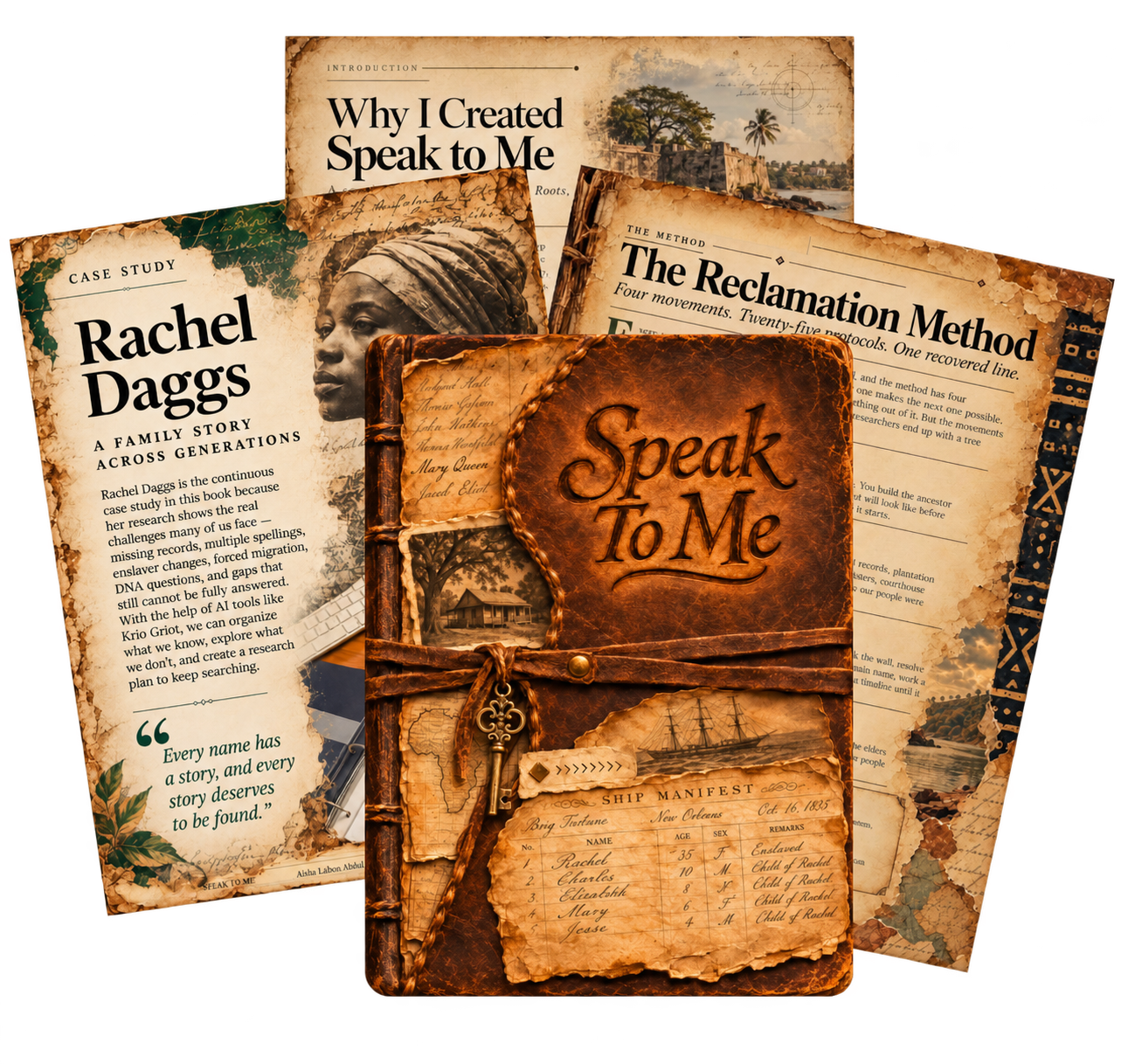
Perhaps you’ve asked AI about an ancestor and received an answer that sounded convincing. Now you’re unsure which details to trust or what to investigate next. Your family history deserves thoughtful interpretation, and you deserve a process for making your own judgments. Without one, an appealing possibility can become a claim repeated without evidence.
In this webinar, I’ll introduce the framework behind Speak to Me and show how its protocols help you move from a research question to a more deliberate practice of searching, evaluating, and preserving.
Gather what you know and give your AI research useful context and direction.
Consider how AI can support searching records and understanding historical context.
Distinguish documented facts from inference and AI suggestions, and return to the sources.
Connect your research with the family records, memories, and stories you want to carry forward.
The Reclamation Method is designed to work with any large language model, including Krio Griot. I’ll explain how the protocols provide a structure you can take to your preferred AI platform.
We’ll look at the book, how the protocols are organized, and how the four movements connect. AI responses remain starting points for investigation; historical conclusions depend on evidence and your judgment.
Archivist · Genealogist · Author
I created Speak to Me to help family historians look beneath an answer: ask a more focused question, notice connections, examine the context, and compare the evidence. The protocols turn that approach into practical steps you can use while deciding what a discovery means and what still needs investigation.
In this session, I’ll introduce the book and the framework so you can see how they relate to your own research and family archives.
For genealogists, archivists, and family historians who want a structured approach to using AI. The book is rooted in African American and African diaspora research.
Bring a notebook and a family history question. You do not need to own the book to attend.
Saturday, November 21, 2026 · 1:00–2:00 p.m. Pacific Standard Time
If the form does not load, open the registration form here. After submitting, use the confirmation link to open your thank-you page and save your Google Meet details.
Registration does not subscribe you to ongoing marketing. Read the Privacy Policy.
An introduction to Speak to Me, its 25 protocols, and the four movements of the Reclamation Method, with an explanation of how to use the framework with your preferred LLM.
No. The framework works with any large language model, including Krio Griot.
Your registration confirmation will provide your Google Meet details and a link to the thank-you page. Save those details before closing the confirmation.
You have a question to investigate, a framework for examining an answer, and a better sense of what needs checking. That is the progress this introduction is designed to support: less uncertainty about the process and more confidence in your next step. Register and begin learning how to put the method into practice.